Valery Gergiev was born in Moscow in 1953 to Ossetian parents. He spent his youth in the Caucasus. For a Russian career at a relatively old age, he learned to play the piano. At the Leningrad conservatory, he studied conducting with Ilya Musin. While still a student, he won the All-Union Conductors’ Competition Prize in Moscow. At the age of 23, he was the winner of the prestigious Herbert von Karajan Conductors’ Competition in Berlin. The following year, he became the assistant conductor to Yuri Temirkanov at the Kirov Opera where, in 1978, he made his debut with War and Peace, productions of Mazeppa, Prince Igor, Lohengrin, etc. followed. From 1981 to 1985, he was the Chief Conductor of the Armenian State Orchestra. He also conducted the leading orchestras of the former Soviet Union. In 1988, he was appointed chief conductor and artistic director of the Kirov Opera which is situated in the heart of St. Petersburg. In 1996, the Russian government appointed Valery Gergiev general director of the Mariinsky Theatre/Kirov Opera. Gergiev even decides on the casting of singers, with a preference for the Italian school over the Russian.
In 1989, Valery Gergiev had his first international success at the Schleswig-Holstein-Musikfestival in Germany. Whereas the Moscow music scene fell into decay in the post-communist era, Valery Gergiev was able to lead the Mariinsky Theater to the level of the best opera houses in the world. He regularly tours the world with it. This summer, amongst others, he was part of the Lucerne Music Festival in Switzerland. Gergiev’s recordings encounted worldwide success and made the the Mariinsky Theater known outside Russia. In this, television productions play an important part. In 1989, Gergiev took over the function as guest conductor at the Rotterdam Philharmonic Orchestera. Four years later, he become its chief conductor. Since 1997, he also works as guest conductor at the Metropolitan Opera in New York. Gergiev has won a lot of national and international prizes, among them the Classic Music Award as Conductor at London’s Royal Albert Hall in 1993. He founded several festivals. He is the Artistic director of the St. Petersburg White Nights Festival founded in 1993, the annual Mikkeli International Music Festival in Finland created in 1994 and, since the autumn of 1996, he is in charge of the Rotterdam Festival and part of Israel’s Red Sea International Music Festival.
In 1991, Valery Gergiev made his European opera debut with the Bayerische Staatsoper, conducting Johannes Schaaf’s new production of Boris Godunov. The same year saw his American opera debut with a new production of War and Peace at the San Francisco Opera. In 1993, Gergiev was named Conductor of the Year at the Classical Music Awards. He has guest conducted most of the world’s leading orchestras, including the Los Angeles Philharmonic, San Francisco Symphony, Amsterdam’s Royal Concertgebouw, London’s Royal Philharmonic, Rome’s Santa Cecilia, Boston Symphony Orchestra, Chicago Symphony Orchestra, Cleveland Orchestra, London Philharmonic, London Symphony, Tokyo’s NHK Symphony and the Berlin Philharmonic.
The Mariinsky Theater was founded in 1860. Its “golden age” began with the appointment of the Czech Eduard Napravnik as assistant conductor in 1863. In 1869, he became the Mariinsky Theater’s chief conductor and shaped it for half a century. Giuseppe Verdi’s La forza del destino had its world premiere at the Mariinsky Theater, in the presence of the composer. Russian operas such as Boris Godunov (1874) and Prinz Igor (1890) as well as the ballet Swan Lake had their debut at the Mariinsky Thater as well parts of Wagners Ring and Tristan, before they were heard in Bayreuth. Tchaikovsky, Rachmaninov, Berlioz, Schönberg and Mahler presented some of their symphonic works at the Mariinsky Theater. Famous conductors such as Alexander von Zemlinksy, Bruno Walter, Erich Kleiber and Otto Klemperer, to mention just a few, conducted here.
Valery Gergiev dedicates a lot of time to the works of Sergei Prokofiev (1891-1953) and Dmitri Shostakovic who both were, like the better accepted Igor Stravinsky and Tchaikovsky, natives of St. Petersburg. Prokofiev had studied with Rimsky-Korsakov and left Russia in the year of war and revolution. He traveled over Japan to the United States. Prokofiev spent 17 years in Western countries and only returned in 1936, in the midst of the Stalinist terror, to the Soviet Union. He was guided by the illusion that, unlike in Paris where he had stayed last, he would not be one composer among others, but the composer and that he would not have to work as a pianist anymore. The politically naive or even ignorant Prokofiev had to make many compromises and serve the Soviet Union through his music. In this field is a birthday hymn for Stalin. Despite that fact, in 1948 at the Congress of the Soviet Composers Union, he was accused of having lost contact with the Soviet people. Prokofiev was completely unprepared for this turn of events; he had thought he would be honored. This was not the end of his career, but, according to witnesses, these accusations shortened his life because he suffered a lot from them. In 1953, before the dictator’s death, he was awarded the Stalin Medal. The composer left an oeuvre of 131 works.
Valery Gergiev considers Sergei Prokofiev one of the most neglected composers. Therefore, for his 100th birthday, he erected a monument for him in the form of a Prokofiev Festival. In the 1990s, he began recording his operas. Among them are War and Peace. In 1993, BBC transmitted the opera over satellite to a public of millions of television viewers in the West. Gergiev has already recorded five of Prokofiev’s eight operas, among them The Mirror and Semyon Kotko.
In 1939, Prokofiev composed the opera Semyon Kotko after a short trip to the United States. He needed to produce a work that would be both popular and politically acceptable, since his ambition to be regarded as the leading Soviet composer had not yet been satisfied. Semyon Kotko is based on the novell I am the son of working people by Valentin Katajev (1897-1987), published in November 1937. The politically correct story premiered at the opera in Moscow on June 23, 1940.
The opera is set in a Ukrainian village in 1918. The revolutionary Bolshevik government in Moscow has made peace with Germany, but much of Ukraine is still under German occupation. The Red Army is advancing, supported by scattered revolutionary partisan units. They are opposed by the German army and Haydamaks, members of a cavalry detachment loyal to the reactionary Ukrainian nationalists. Semyon Kotko has returned home after four years in the war as a gunner in the Russian army. He tells his friends in the village about the revolution and hopes to marry his beloved fiancée Sofya (Sonya), daughter of the rich peasant Tkachenko. But her father does not accept Semyon Kotko as his son-in-law. As German troops arrive in the village, Tkachenko hands over a list of names with people who support the revolution to them. Among them is Semyon Kotko who is sentenced to death, but saved at the last minute. There would be nothing in the way of a marriage with Sofya, but the revolutionary leader convinces the lovers to serve the fatherland first and help to liberate the country from its enemies.
For Semyon Kotko, Prokofiev studied the folk songs of Ukrainian peasants. He integrated their distinctive intonation in his melodies. He uses musical satire to describe the different social classes. Katayev and Prokofiev seem to have ignored the fact that after the Soviet collectivization of agriculture in the Ukraine and the subsequent famine some 15 million people starved to death. In the opera of course, nothing is said about this genocide caused by the Soviets. Prokofiev seems to have been satisfied with the music because, for years later, he used themes from Semyon Kotko in a symphonic suite in eight movement of the same name.
Valery Gergiev’s new production of Semyon Kotko premiered at St. Petersburg’s White Nights Festival of 1999. Later, it became as great success at the Wiener Konzerthaus, again under the direction of Gergiev and with the orchestra and the singers of the Mariinsky Opera/Kirov Choir and Orchestra.
Another recent CD by Valery Gergiev, in collaboration with the French pianist Jean-Yves Thibaudet, is dedicated to the Concert for piano op. 16 by Edvard Grieg and the Concert for piano op. 21 by Frédéric Chopin (Decca). Jean-Yves Thibaudet is accompanied by the Rotterdam Philharmonic. The pianist’s passionate play in the finale of the Grieg concerto as well as in the introspective passages is admirable, whereas the orchestra under the direction of Gergiev, besides convincing expressive moments, offers some embarrassing ones.
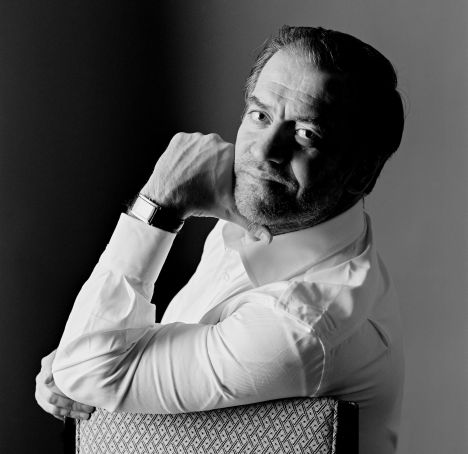
Valery Gergiev. Photo Copyright Decca.
Added on May 25, 2005: In January 2007, Valery Gergiev will become the principal conductor of the London Symphony Orchestra – one of the world’s ten leading orchestras – and one of my favorites.
Prokofiev: Semyon Kotko. July 2000. 2 CDs. Philips/Universal. Order it from Amazon.com or Amazon.co.uk
Prokofiev: The Gambler. 1999, 2 CDs. Philips/Universal. Order it from Amazon.com or Amazon.co.uk
Prokofiev: War and Peace. 1993, 3 CDs. Philips/Universal. Get it from Amazon.com
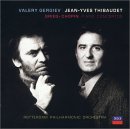
Gergiev and Thibaudet: Grieg, Chopin. Order it from Amazon.com and Amazon.co.uk.
Article added in November 2000, last update: January 30, 2006


