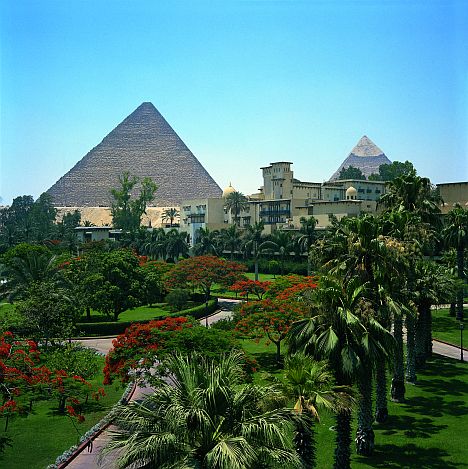
History, photos and anecdotes of the hotel located near the Great Pyramid in Giza
The management contract with the Indian Oberoi group ended on December 31, 2012. The Egyptian General Company For Tourism & Hotels (EGOTH) is currently selecting a new management companies, with several bidders remaining.
I last stayed at the Mena House Hotel in 2012. The Oberoi General Manger at the time was Mohit Nirula. He told me about the renovation project which, unfortunately, was not carried through as planned in the summer of 2012.
However, the historic building of the Mena House Hotel with its public spaces and private rooms needs a renovation. Especially the bathrooms and the air-conditioning system have to be replaced. The rest of the landmark building should undergo a soft renovation, retaining the fabulous style of this unique property.
Customers should not worry about the renovation closing because there is an entire new complex behind the historic Mena House with contemporary rooms, a great gym, outdoor pools and restaurants. The hotel will remain open for business during the renovation of the historic building!
Last but not least, I forgot to write one great story from my 2007-visit, when I had a look at the guest book together with vice-director Tarek Lotfy. During the Second World War, the commander of the German forces, Erwin Rommel, stayed at the Mena House. After the battle of El Alamein, a certain Field Marshall Montgomery was a guest of the luxury hotel too. He proudly signed the same page of the guest book as the famous “Desert Fox” had with the proud words: “Montgomery of Alamein”! [added on Jan. 30, 2013].
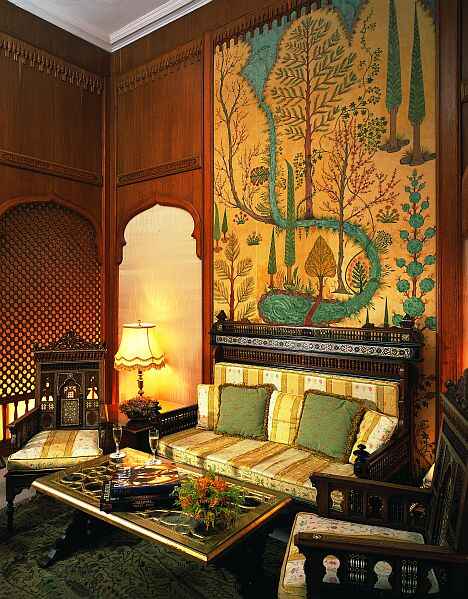
An Executive Suite. Photos © The Mena House. Read the book by Andreas Augustin: The Mena House Treasury (88 papes; Amazon.com, Amazon.co.uk). Books about Cairo and Egypt from Amazon.com, Amazon.co.uk, Amazon.fr, Amazon.de.
There are luxury hotels and there are legends. The Mena House, an Oberoi hotel, belongs to the latter category. Located before the ascent to the Great Pyramid in Giza, just about an hour by taxi from Cairo airport, it offers an oasis – quite literally as well as figuratively – of wellbeing, comfort, class and style at the fringes of the Egyptian desert.
Napoleon’s conquest of Egypt in 1797, with the treasures he subsequently brought to Europe, as well as Giovanni Belzoni’s research from 1815 onwards spread Egypt-mania around the globe. The land of the Pharaohs became a major attraction for travelers. The opening of the Suez Canal in 1869 further increased the attraction of the ‘exotic’ destination. Thomas Cook’s first trip to Egypt took place the same year.
Incidentally, the Great Pyramid is the oldest and tallest of the pyramids in Giza. Built around 2560 BC, it is also known as the Pyramid of Khufu or the Pyramid of Cheops. According to the ancient historian and priest Manetho, Khufu aka Cheops, the second pharaoh of the Fourth Dynasty, reigned for 23 years from 2589 to 2566 BC. It is only possible for a limited number of visitors to climb into the Pyramid. I had the chance to do so. There is nothing to see inside. Still, once you are there, you wish to see it with your own eyes. Most impressive is to stand in front of it or, if you are lucky like me, just to watch it from your room’s private balcony at the Mena House.
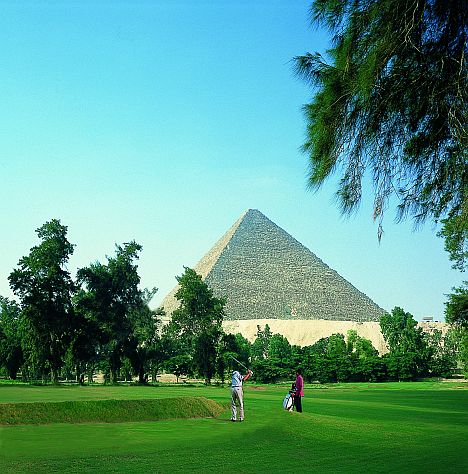
The Mena House’s golf course near the Giza pyramids. Since 1899, hole 18 of the hotel’s golf course has been located near the Great Pyramid. The daily irrigation in the early morning has created an oasis at the edge of the desert. Photo copyright © The Mena House, an Oberoi luxury hotel.
The Mena House hotel grew out of a former Khedival hunting lodge close to the Great Pyramid. Incidentally, Muhammad Ali – not the box champion – who had restored the Ottoman Empire’s authority in Egypt after Napoleon’s defeat and subsequently became the Pasha and Wāli of Egypt, had claimed the grander title of Khedive for himself and his successors. The Khedival lodge was a two story house nicknamed the ‘mud hut’ built in 1869 for King Ismail the Magnificent. He used it for himself and his guests, whilst hunting in the desert or visiting the pyramids at Giza. The Khedive lodge was enlarged and Pyramid Road from Cairo to Giza was built for the visit of Empress Eugenie in 1869.
Until today, the Mena House remains by far the most famous hotel near the Pyramids in Giza. In 1883, Frederick and Jessie Head bought the Khedival hunting lodge on their honeymoon. They enlarged it and built a second floor. Jessie gave English lessons to local children. The Heads sold the lodge to the English couple Ethel and Hugh F. Locke-King. They started building the Mena Hotel, as it was called at the time, in 1885. It opened the following year. Objects from that time still used today include an ancient door.
The hotel is named after the founding father of the First Egyptian Dynasty, Mena. Known as Aha or King Menes of Memphis, he founded the city of Memphis and unified Upper and Lower Egypt into one kingdom.
The Mena House is famous for its turned wood spool work, traditionally made of beech and mahogany wood, some stemming from Harem windows. Mashrabia aka Mashrabiya carved woodwork was introduced to Egypt during the Islamic period, from 750 AC onwards.
The English couple Locke-King not only used Mashrabiya windows, but also brass embossed doors, blue tiles, mother-of-pearl and mosaics of colored marbles to build a fairy-tale palace next to the Great Pyramid. According to Andreas Augustin, the great dining hall was an exact replica of a Cairo mosque.
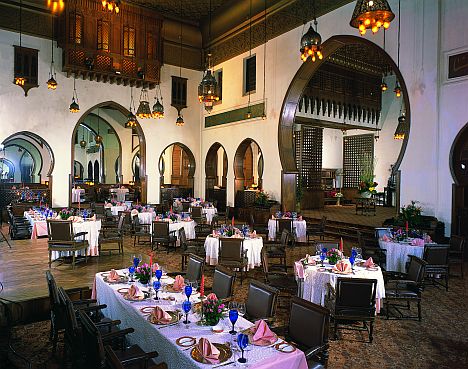
View of the restaurant Al Rubayyat. Photo © The Mena House.
In 1887, the first guests arrived by coach from Cairo, at a time when the Opera House announced 80 performances for the following season. On December 24, 1871 already, Verdi’s Aida had premiered at the Cairo Opera House.
The Austrian Baron Ernst Rodakowski was the first general manager of the Mena House. He was a friend of Locke-King and managed to bring it up the level of the world’s luxury hotels. However, the Locke-Kings were less successful in making their hotel profitable, being too generous when it came to hosting friends.
Initially, the Mena House offered 80 bedrooms with 10 foot high ceilings, horse riding, a golf course, two lawn tennis courts, a library, a billiard room, the services of a French chef in the fashionable restaurant as well as of the Italian photographer Fasani, who had his studio at the hotel.
The German managing director G. A. Loedlick from Frankfurt hired the English physician Barry-Blacker and therefore, made the first step in the direction of the creation of a fashionable spa near the pyramids. In 1890, the Mena House opened the first hotel swimming pool in Egypt. The same year, it was the first hotel to announce that it would stay open all year long and no longer close during the hot summer season.
Among the 19th century travelers of world fame was the Prince of Wales, who honored the Mena House in 1889. Sir Arthur Conan Doyle, together with his wife Louise, diagnosed with ‘consumption’ (today known as tuberculosis), stayed at the luxury hotel in the winter season 1894-95. Subsequently, he revived his hero Sherlock Holmes, whom he had ‘killed’ in 1894.
In 1894, Baron Rodakowski bought shares in the hotel from the couple Locke-King. In 1896, the Mena House partly changed hands again. The hotel was bought by Emil Weckel and a certain Mr. Schick. The hotel had its own stables with Arab and English horses and desert carts for hire. Andreas Augustin also notes that “fresh milk was delivered daily from the Mena House diary with medically-examined cows.” Two years later, Baron Rodakowski sold his hotel shares.
In 1904, Schick and Weckel sold the Mena House to George Nungovich’s company. Nungovich had started as a porter at Cairo’s train station. The self-made man was to build a hotel empire in Egypt including the Angleterre, Savoy, Grand Continental and Mena House hotels. August Wild became the company’s managing director. It was Wild who, in 1909, arranged for a banquet near the Pyramids for the Prince and Princess of Wales, the future King George V and Queen Mary. It took place in the chalet built for Empress Eugénie in 1869.
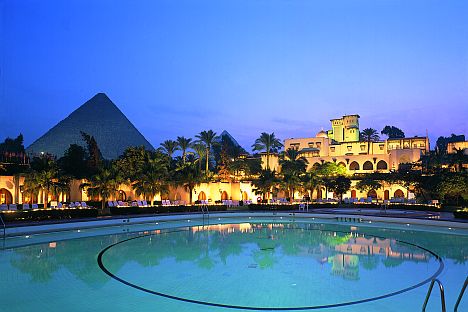
View from the hotel pool. The little hotel towers are not housing suites, but the lifts of the Mena House. The first was added in 1900, the year in which all floors and all public spaces received electric light. Photos copyright © The Mena House.
In 1914, the First World War brought major changes to the Mena House which was temporarily requisitioned by the Australian troops. The management had to break away from the ‘no-pets rule’ when the Australians brought in a baby kangaroo. Towards the end of the war, the hotel became a hospital.
The First World War brought Winston Churchill to the Mena House for the first time. He fell in love with the luxury retreat and became a lifelong regular visitor. The Churchill Suite at the Mena House pays tribute to this story.
During the First World War, an Australian officer was caught naked chasing a woman through the hotel corridors. In his defense, he quoted an Australian army regulation which stated that an officer may wear any costume appropriate to the sport in which he is engaged [corrected on August 10, 2013: Australian, not Austrian officer].
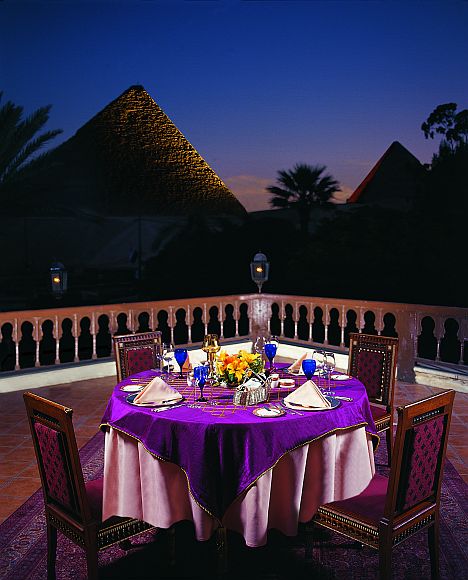
The view from the Montgomery Terrace. Photo © The Mena House Oberoi hotel.
After the First World War, Europeans and Americans embarked again on the Grand Tour. Therefore, in 1920, the Mena House added 30 rooms to its capacity. In 1922, Fuad became king. More important for tourism, Howard Carter discovered the tomb of Tutankhamen.
The outbreak of World War Two in 1939 did not cripple tourism in Giza. People were dancing on a volcano. The Mena House was fashionable with everyone in Cairo who wanted to be seen. From time to time, King Farouk raced his red sports car through Pyramid Road to the Mena House for a drink. When ordering a plate of his favorite spaghetti with tomato sauce, he always spoke Italian with the head waiter Bennini.
Egyptians and the Europeans in Egypt enjoyed the gaiety while Europe and the other parts of the world fell in ruins. The Mena House was the perfect place for information and rumors, e.g. about Rommel conquering Libya and soon reaching El-Alamein. The British rushed to Cairo in panic.
In 1939, the Mena House was filled with soldiers from Australia once more. In July 1942, the British troops were pushed back to Alexandria, but in November Field Marshall Montgomery and his Eight Army won the second battle of El Alamein against Rommel. Montgomery has also a suite dedicated to his memory at the Mena House. I had the chance to have a look at the suite and was impressed. The furniture in the sitting room and a door stem from the palace of Huda Shaarawi, the first notable feminist in Egypt. Together with historic photos of ‘Monty’, the decor creates a unique atmosphere.
In November 1943, Chiang Kai-shek, Roosevelt and Churchill gathered in Egypt for the Cairo Conference and agreed that Japan would be forced to give up China and to surrender unconditionally. Operation Overlord, the invasion of Europe had to be discussed. The Mena House Hotel became the conference’s headquarters and the venue of all all the British and American chiefs of staff. The hotel was protected by 500 anti-aircraft weapons. An RAF observation post was even installed on top of the Cheops Pyramid.
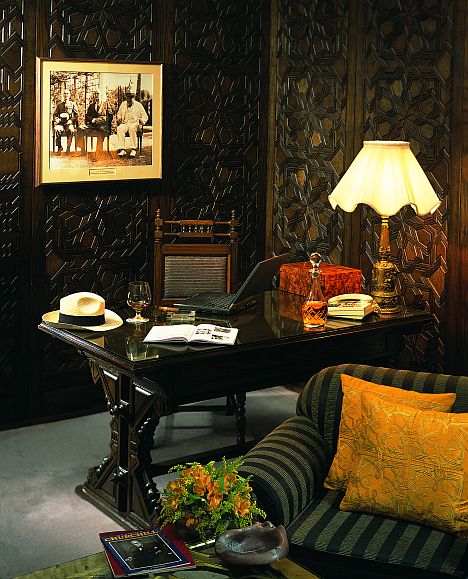
The Churchill Suite. Photos © The Mena House.
In 1952, British rule and the Egyptian monarchy had become intolerable in the eyes of the many locals. The so-called Free Officers conspired against King Farouk and forced him into exile, fleeing on his royal yacht. His son Fouad became king, but only for one year. In 1953, the Free Officers declared Egypt a Republic. Gamal Abdel Nasse became president in 1956 and remained it until his death in 1970. In this period, the hotel was nationalized.
In 1964, a fire broke out at the night club of the Mena House, which still existed when I stayed there. But I was told that it was about to disappear in favor of a restaurant. Nightclubbing at the Mena House does not seem to be fashionable anymore.
In 1971, the Mena House had already been nationalized for some time and was in a poor state. Rai Bahadur Mohan Singh Oberoi (1898-2002), the founder of the Indian Oberoi hotel group, identified it as a valuable property and in agreement with president Sadat, took over the management, which the Oberoi Group holds until today. In 1979, Newsweek picked Mohan Singh Oberoi as ‘Businessman of the Year’, together with Sir Freddie Laker and Roland Peugeot. Incidentally, Oberoi pioneered the employment of female staff in his Egyptian hotels. In 1985, Egypt awarded him with the Order of the Republic for his outstanding contribution to the country’s tourist industry. The hotel group is currently run by his son, P.R.S. ‘Biki’ Oberoi, the Chairman and Chief Executive Officer of EIH Limited, the flagship company of The Oberoi Group.
From 1972 to 1975, the Oberoi Group totally renovated the Mena House and its Gardens with taste, preserving its unique atmosphere. In 1974, president Nixon lunched at the hotel., which was officially reopened on Christmas Day 1975 by Prime Minister Salem. After the renovation, a first comprehensive history of the hotel was published by Nina Nelson.
Presidents Sadat and Carter received the pure golden keys of the Mena House from general manager Homi J. Wadia. President Carter appreciated the gesture but had to return the keys the next day because, at the time, American presidents were not allowed to accept presents worth more than $50. During the Egypt-Israel talks in 1979, Carter stayed at the Churchill Suite, Sadat in the Montgomery Suite and the Israeli Premier Menachem Begin occupied suite 908. As we all know, Sadat paid with his life for his historic peace initiative. People like him are still needed in 2009, as Israel’s war against Hamas shows. In 1979 at the Mena House, thanks to the tight security, a suitcase with a bomb was detected in time.
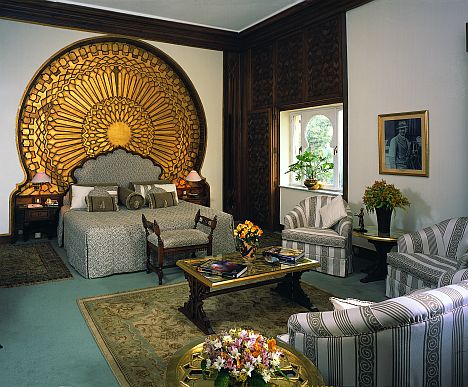
A Deluxe Suite. Photos © The Mena House, an Oberoi hotel.
In 1978 a garden wing with 200 rooms was added to the historic Mena House property. At the end of 2007 and in 2008, it underwent a complete reconstruction. I had a look at some of the rooms. They were of the highest standard. In 2009, the new wing called the Mena Garden will remain open, whereas the historic Palace wing will be closed for renovation.
In 1989, the Oberoi took over the management of a coffee shop and restaurant named in honor of the Nobel Prize winner for literature, Naguib Mahfouz, situated in the heart of the historic Cairo bazaar Khan El Khalili.
In April 2000, 1500 of the world’s leading Egyptologists held their World Conference in Cairo. The Mena House in Giza became one of its natural centers. The hotel also arranged a banquet at the foot of the Sphinx.
A hotel employee told me that, some two decades ago, when it was already forbidden, a guest asked him if they could climb a pyramid together at night. Getting down afterwards was the most terrifying experience in his life, he confessed.
Incidentally, in 1928, the Prince of Wales and Duke of Windsor teed-off from the summit of the Great Pyramid. After playing golf, he had a swim in the Mena House pool. Frank Sinatra, Julio Iglesias and Gloria Gaynor are three famous singers who entertained guests at the Mena House. Pierre Balmain and Bulgari held fashion shows in the hotel. The Shah of Persia, Reza Pahlavi, stayed at the Mena House after Ayatollah Khomeini had driven him into exile in 1979. The Shah had married Princess Fawzia, a daughter of Egypt’s former King Fouad. The Shah stayed four days at the Mena House and met with President Sadat. He then retired to the privacy of Kubbeh Palace where he died from cancer in July 1980.
Among the many celebrities staying at the Mena House, let’s also mention the regular guests Omar Sharif, Sir Peter Ustinov and Charlton Heston who rode a horse into the hotel garden every afternoon after filming the Ten Commandments. Robert Taylor and Eleanor Parker shot large parts of Valley of the Kings at the Mena House. Roger Moore enjoyed the Mena House during the shooting of the Bond movie The Spy Who Loved Me.Peggy Guggenheim, Karim Aga Khan and the Begum, Jane Fonda and Um Kalthoum, were other actors, musicians, politicians and celebrities staying at the luxury hotel.
Last but not least, I recommend one of the hotel’s restaurants, the Moghul Room, which serves Indian dishes in an elegant atmosphere with occasional Indian music. It will be transferred to the current night club’s location, although I was charmed by its decor, food and music. Unfortunately, I had no chance to speak with the chef who was busy with preparing an important event that night.
In short, you will never forget the Mena House for its culinary delights, its artistic, relaxing and stylish decor, its sporting possibilities and its views of the unforgettable millenary sights nearby.
By summer 2009, the renovation of Mena Garden will be completed with two new signature restaurants, a new swimming pool, a health spa as well as some 400 rooms. The historic Palace with some 100 rooms will be closed for restoration as of May 2009 for a period of 10 months. Hotels are works in progress.
Sources
In addition to information provided by the Mena House and the Oberoi hotel staff, mainly Tarek Lotfy, Andreas Augustin’s book The Mena House Treasury (88 papes; Amazon.com, Amazon.co.uk) was a valuable source for this article.
Books about Cairo and Egypt from Amazon.com, Amazon.co.uk, Amazon.fr and Amazon.de.
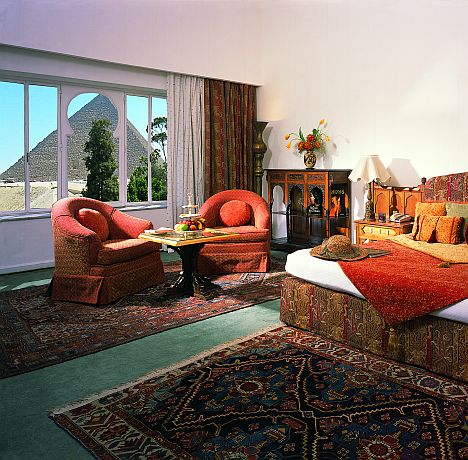
A Deluxe Room with pyramids view before the renovation. I stayed in a such a room, but with a balcony. Photos © The Mena House.
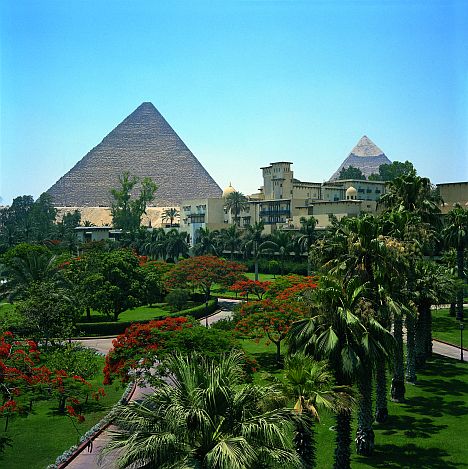
Hotel view from the garden with two Giza Pyramids in the background. Photo © The Mena House, an Oberoi hotel.
Article added on January 14, 2008; last update on January 22, 2008. Added to our WordPress pages in 2019.


