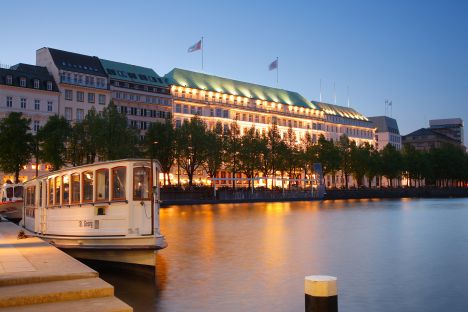
Review, photos and history of the luxury hotel
There are only two true “Four Seasons” in the world, the one in Munich and the one in Hamburg. The historic landmark Vier Jahreszeiten in Hamburg has become a Fairmont Hotel in 2007. It went through a €25 million renovation from January 2008 to September 2010 in which for instance over 250 antiques were restored. Highlights include the suites named after Maria Callas, Prince Heinrich, Thomas Mann and Sir Peter Ustinov as well as the Presidential Suite with its 260 m².
Before 2012, I have stayed at the Hanseatic hotel Vier Jahreszeiten in 2004 and 2007. My last arrival on February 24, 2007 coincided exactly with the 110th year of its opening. I stayed in room 312, a junior suite with an Inner Alster Lake (Binnenalster) view. If you have the choice, always go for the lake view. That’s what I did again in 2012. The nine Deluxe Double Rooms with balconies on the fifth floor offer the best price-performance-ratio.
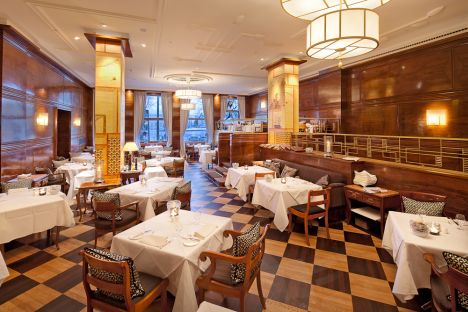
The Jahreszeiten Grill in its original Art Déco splendor. For many years, the Art Déco features had been hidden. Photos © Fairmont Hotel Vier Jahreszeiten, Hamburg.
Friedrich Haerlin, the founder of the Vier Jahreszeiten
Friedrich Haerlin (1857-1941; source: Sepp Ebelseder, Michael Seufert: Vier Jahreszeiten. Hinter den Kulissen eines Luxushotels. Die Hanse, Hamburg, 2002, 460 S. Erstausgabe 1999, Rowohlt. Order the book in German from Amazon.de, Amazon.com), a native Swabian born in Gaisburg near Stuttgart, was the youngest of four children of the local master baker, who also run an inn, a farm and a haulage business. Because of an allergy, the boy could not take over the bakery. Even worse, his father had to declare bankruptcy in the 1873-crisis. Three years later, the 17-year old son decided to try his fortune abroad. He took the train from Stuttgart to Geneva (German article) and landed a job at the railway station restaurant in the Swiss city. He worked hard and learned French. Therefore, a fellow German offered him a job in his elegant café-restaurant. After a few other jobs, for instance in a hotel in Menton on the Côte d’Azur, he went to a Southampton hotel to learn English. After a year, thanks to his brother, an architect, Friedrich Haerlin landed a job as a waiter at the famous Zurich hotel Baur au Lac, founded by the Austrian Johann Baur in 1844. The hotel director at the Baur au Lac took the Swabian waiter with him to Cannes, where he spent the winter season.
In 1882, Friedrich Haerlin was offered an opportunity that changed his life, the book-keeping job at the best address in Bern, Hotel Bellevue, situated next to the Swiss Parliament. As early as in autumn 1883, after the death of her husband, Philippine Oswald made Friedrich Haerlin director of Hotel Bellevue and doubled his salary. The Swabian was very successful and offered a part of the profit. He even wrote special clauses into his contract for the case that he would get married or that the sons of the hotel owner’s widow would take over the hotel.
In 1891 Friedrich Haerlin met his future wife Thekla Toussaint from Bremen, the daughter of a successful hatter and herself the best gymnast and swimmer in her sports club. They married in 1893 and took over the management of Hotel Bellevue in Thun. When the ownership changed and he disagreed with the new business strategy, he quit and sold his part of the hotel stocks.
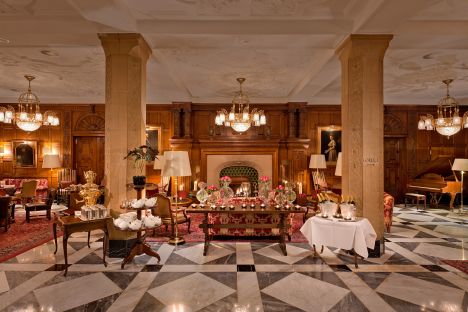
“Hamburg’s Living Room”, the famous Wohnhalle / Lounge at the Vier Jahreszeiten. Photos © Fairmont Hotel Vier Jahreszeiten, Hamburg.
Birth of a legend
On February 1897, on his 40th birthday, Friedrich Haerlin purchased a small hotel in Hamburg with 12 rooms and a restaurant for 420,100 mark, inspired by the Swabian saying: “At 40 you’ll get clever”.
The hotel’s address, Jungfernstieg, can be translated as “virgins promenade”. It was where the wealthy families would walk their unmarried daughters in search for a good match.
Friedrich Haerlin invested 100,000 mark in his new hotel and, the same year, his wife gave birth to their fourth child, Fritz, who would later take over the Vier Jahreszeiten. Because Friedrich saw no chance to buy the next door building to enlarge his small hotel, he even thought about selling it and moving to Switzerland. Only because he got no offers, he decided to stay in Hamburg.
Friedrich Haerlin put a lot of emphasis on the service in his hotel, which quickly attracted celebrities such as the composer and pianist Eugen d’Albert. When the next door physician moved to a posh suburb, Friedrich Haerlin first managed to rent parts of the man’s house and, in 1903, convinced the physician to sell it to him. One by one, the hotelier bought all neighboring houses and turned them into one luxury hotel. In 1905, he changed the name to Grandhotel Vier Jahreszeiten, which already featured 57 rooms. In 1911, it had been enlarged to 140 living and bedrooms with 50 bathrooms and telephone lines to all rooms. By 1934, today’s size was reached. No additional buildings have been bought since then. The present-day hotel features 156 rooms and suites, several restaurants, private rooms, a large gym and more.
The rich and famous continued to stay in Haerlin’s hotel. When the wealthy ship owner Albert Ballin had his palace-like Villa am Rothenbaum built, he stayed with his wife and child at the Vier Jahreszeiten all through the autumn and winter of 1908/09.
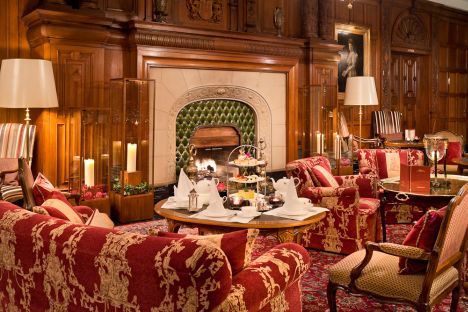
The traditional Afternoon Tea is served in the Lounge. Photos © Fairmont Hotel Vier Jahreszeiten, Hamburg.
The wars
After economically tough times during the First World War, when the military had occupied the hotel, Friedrich Haerlin renovated the Vier Jahreszeiten with the help of his wife Thekla and his son Fritz. They opened Restaurant Haerlin, which quickly became Hamburg’s first culinary address. During the great inflation in the 1920s, Friedrich managed to buy 35,000 bottles of the best German and French wines with the soon worthless paper money.
In the 1920s, his son Fritz worked in hotels in Scandinavia, Switzerland and Madrid’s Ritz Carlton. The leading hotel trade newspaper, the New York Hotel Review, was impressed by the fact that Fritz began his career in New York City’s hotel Astor, which later became the Waldorf Astoria, as a simple waiter, although, as the heir to a famous hotelier, he could have gotten a much better job.
In 1932 Fritz Haerlin took over the hotel from his father. He was a man of contradictions. He joined the infamous SS in 1933 and became a Nazi party member in 1937. At the same time, the Vier Jahreszeiten remained an Island of the Blissful from 1933 to 1945, where no Nazi propaganda and meetings took place. He hosted Jews and tried but did not manage to have his Jewish concierge flee the country because of a Gestapo intervention; the poor man died in a concentration camp. More details can be found in the German article Das Vier Jahreszeiten von 1933 bis 1945.
Friedrich Haerlin died in 1942, his wife the following year. Fritz was the only one of three sons who survived the war. He married Agnes Annemarie Knoops in 1942. She had worked as an intern at the hotel. Their daughter Thekla Clara was born the following year. Their second daughter Annemarie was born in 1944.
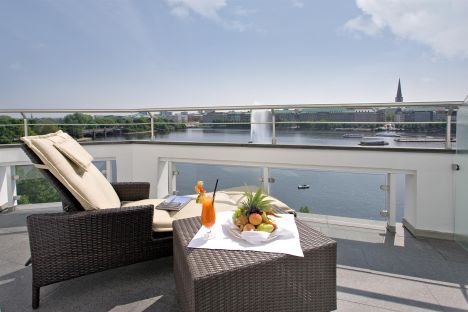
The view from a Bel Etage balcony on the 5th floor. Renovated in 2010, the nine Deluxe Double Rooms on the fifth floor offer the best deal, with two chairs, a table and one or two deckchairs on the balconies overlooking the Binnenalster. Photos © Fairmont Hotel Vier Jahreszeiten, Hamburg.
From WWII to the present
On May 3, 1945 the Vier Jahreszeiten became the British headquarters. The officers quickly found the hidden wine bottles, cognacs and silverware. Before he got his hotel back, Fritz Haerlin ran a restaurant in Hamburg. A Belgian friend working for him managed to get a job at the British headquarters and, together with others, they managed to smuggle out of the occupied hotel silverware, porcelain, rugs, antiquities and more.
Friedrich Haerlin had most of the furniture and other objects stamped with a hotel sign. Therefore, Fritz managed to get a lot of the family properties back. Even a general was forced to give back expensive bedroom furniture. Therefore, many antiques as well as 16th and 17th century Flemish tapestries collected by the Haerlin family are still displayed all over the Fairmont Hotel Vier Jahreszeiten today.
With the little money he made from the small rent paid by the British occupiers, Fritz Haerlin prepared himself for the day he would get his hotel back. This day came on January 30, 1952. On April 3 already, he re-opened the Vier Jahreszeiten.
Among the famous guests who stayed at the hotel since then, let’s just mention the legendary ship owner Aristotelis Onassis. One late evening, the regular guest saw the concierge, who could not hide it in time, eat a butter bread. The hungry billionaire asked what it was and then asked for a bite. The Greek was enthusiastic and henceforth, the concierge and the billionaire would share simple butter breads at night.
The Vier Jahreszeiten was also the place where the love affair between Aristotelis Onassis and the celebrated soprano Maria Callas partly unfolded, especially in 1959 and 1962.
In 1966 the Vier Jahreszeiten joined The Leading Hotels of the World. Unfortunately, Fritz Haerlin was not as business-savvy as his father. The downfall accelerated for a while after Fritz Haerlin’s death in 1975. His widow, Agnes, wanted to see the world. Her daughters were not happy with their mother’s spending habits. Worse, mother Agnes fired many of the leading staff and rehired some of them afterwards at higher salaries.
Luckily, in 1968, Fritz Haerlin had hired Gert Prantner (*1940) from the Vier Jahreszeiten in Munich. He had studied at Cornell University in Ithaca. Prantner was one of those who had been fired and re-hired. He convinced Agnes Haerlin to reinvest in the hotel. He modernized the budget planning, marketing and introduced computers. From 1975 to 1989, Pratner tripled the hotel’s turnover.
On March 1, 1983 Agnes Haerlin did not only celebrate her mother’s birthday, but the tax fraud office searched Agnes’ villa too and found a secret Swiss bank account with two million mark. The lady fled to Salzburg, because Austria does (or at least did) not extradite tax evaders. In 1987, a court ordered her to pay 2,4 million mark plus an additional 1,1 million mark. She stayed in Austria. When her daughters got the news by phone of her death in Salzburg in 1992, Gert Prantner heard daughter Thekla exclaim: “Anne, mother just died. Champagne!”
In December 1989, the Japanese Hiroyoshi Aoki offered 215 million mark for the Vier Jahreszeiten. The previous year, he had bought the Westin chain with 80 hotels. On December 27, 1989 the 92-year era of the Haerlin family at the Vier Jahreszeiten came to an end.
After the 1990-Gulf War, the Aoki team tried to save as much money in the hotel as they could. Gert Prantner left the hotel in 1993. The service culture was lost. The turnover shrank from 35 to 24 million mark. The hotel lost a lot of its standing.
In 1997, the Raffles Group took over the hotel and appointed Ingo C. Peters as its new director. In 1982, Peters had started his career in the Hamburg hotel as the bellboy before studying at Cornell University in New York and leading the Phuket Yacht Club in Thailand, the Mandarin Oriental in Jakarta as well as several Ritz Carlton hotels.
Renamed the Fairmont Hotel Vier Jahreszeiten on April 30, 2007 the luxury hotel in Hamburg distinguishes itself by its tradition, continuity and subtle innovations – I appreciated the Loewe flat screen HDTV in my room. Above all, the hotel has always impressed me with its excellent staff. People make a difference!
In 2012, Ingo C. Peters is still the hotel’s director. He made it again one of the best in Germany by avoiding pomp and keeping the hotel philosophy simple: “service, service, service.”
If you read German, check our series of seven articles about the hotel from 2004, starting with the one about Friedrich Haerlin, which offer plenty of additional details. The main source for this article is the German book by Sepp Ebelseder and Michael Seufert: Vier Jahreszeiten. Hinter den Kulissen eines Luxushotels. Die Hanse, Hamburg, 2002, 460 pages. Order it from Amazon.de. Order the first edition of the book, Rowohlt, 1999, from Amazon.de. Purchase books about Hamburg from Amazon.com, Amazon.co.uk, Amazon.de.
The luxury hotel situated at the Jungfernstieg. Photos © Fairmont Hotel Vier Jahreszeiten, Hamburg.
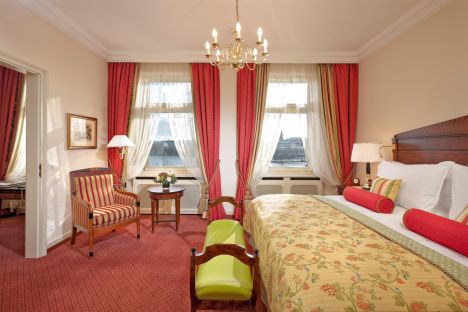
Thomas Mann Suite. Photos © Fairmont Hotel Vier Jahreszeiten, Hamburg.
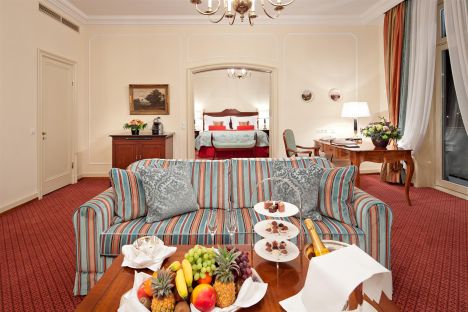
A view of one of the Celebrity Suites. Photos © Fairmont Hotel Vier Jahreszeiten, Hamburg.
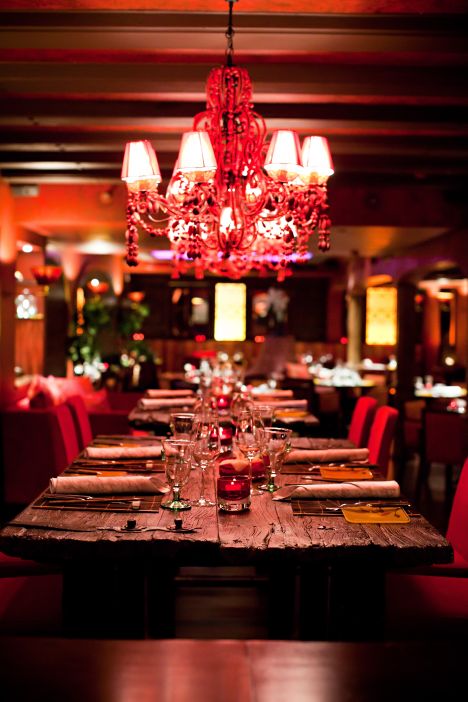
The Chef’s Table at Doc Cheng’s Restaurant, established when the hotel was owned by Raffles. Photos © Fairmont Hotel Vier Jahreszeiten, Hamburg.
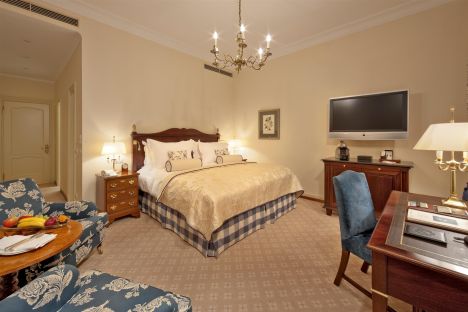
A Deluxe Double Room Courtyard. It is the lowest category of rooms in the hotel that I would recommend. Photos © Fairmont Hotel Vier Jahreszeiten, Hamburg.
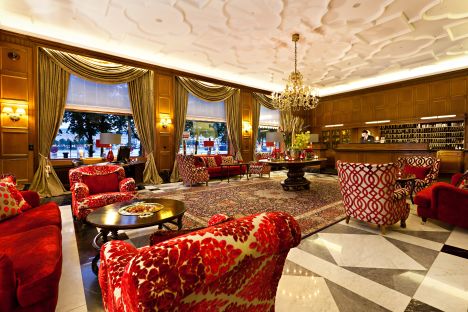
The Lobby. Photos © Fairmont Hotel Vier Jahreszeiten, Hamburg.
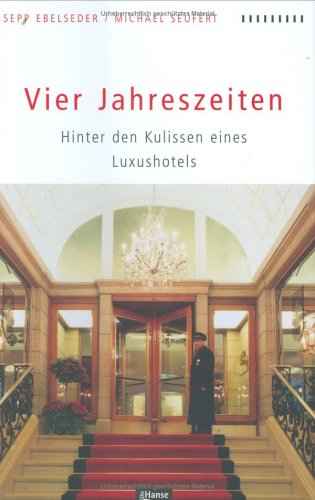
The main source for this article is the German book by Sepp Ebelseder and Michael Seufert: Vier Jahreszeiten. Hinter den Kulissen eines Luxushotels. Die Hanse, Hamburg, 2002, 460 pages. Order it from Amazon.de. Purchase the first edition of the book, Rowohlt, 1999, from Amazon.de. More books about Hamburg from Amazon.com, Amazon.co.uk, Amazon.de.


