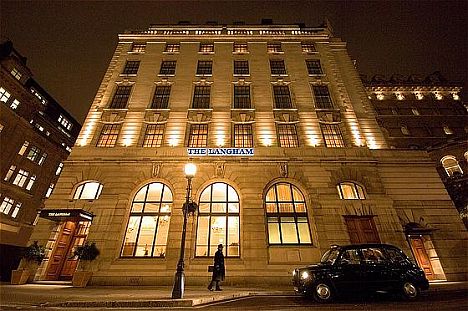
The first purpose built hotel in London, established in 1865
Added on January 17, 2011: I have visited the hotel again, now part of Langham Hotels International and fully refurbished. I recommend to stay in an Executive Room such as room number 613. With its calming green colors and a large bathroom, it is the best deal. Otherwise go for a Junior Suite such as 802, where I stayed. If you can afford it, the hotel features a series of elegant suites. The new restaurant Roux at the Landau opened on November 24, 2010.
Article added on February 6, 2004: The Langham, London opened under its new name in May 2004, owned and managed by the Great Eagle Hotels Group in Hong Kong, which already runs the Hong Kong and the Boston Langham. In February 2004, Duncan Palmer became the new General Manager. He formerly occupied the same position at the Sukhotai hotel in Bangkok.
The Langham London, established in 1865, was the first purpose built Grand Hotel in the British capital and the epitome of Victorian chic. In the early 19th century, London had become the Western World’s largest city ever with over one million inhabitants. It was the center of an empire which controlled a quarter of the earth’s population. Still, it lay far behind the Continent and the United States regarding restaurants and hotels.
The city’s first large hotel, the Great Western Railway Royal Hotel, opened in 1852. Designed by Philip Hardwick, it had 165 rooms and was an instant success. Twelve years later followed the Charing Cross Hotel at the foot of the Strand, designed by E. M. Barry.
However, London still experienced a shortage of hotel bedrooms, especially of high standard. The travel agent Thomas Cook had only two hotels to offer to his customers. For richer travelers, he arranged lodgings in private homes.
In 1862, the Langham Hotel Company held an architectural competition, comfortably won by John Giles of Craven Street. The hotel’s foundation stone was laid on July 17, 1863. On June 10, 1865 His Royal Highness the Prince of Wales opened The Langham. By the way, his “private view” of the hotel was not so private since 2000 aristocrats and dignitaries were invited too.
The hotel’s name goes back to Sir James Langham who, in 1820, had built a mansion on the site, subsequently named Langham Place. It was 95 feet above the Thames high water mark on fine gravel soil, much healthier than the peat bogs in Belgravia nearer the Thames, favored by other hoteliers. In fact, the area was regarded as London’s healthiest, with a much lower death rate than any other of the city’s districts.
The water supply came by way of an artesian well reached by borings into the chalk-basin at a total depth of 365 feet below the basement floor of The Langham. With the help of two fourteen-horsepower pumps, it was possible to pump 25,000 gallons of water to the iron tanks in the cupola tower, from where it was distributed throughout the building into its over 600 rooms, including 34 suites and over 200 single and double bedrooms.
Italian craftsmen had designed and cast the plaster relief ceilings and laid intricate mosaic flooring, decorated in white, gold and scarlet. Moorish murals in the public rooms, inspired by Owen Jones, marble pillars, silk hangings, hand-printed wallpapers and 15,000 yards of Persian tapestry carpet created a sumptuous atmosphere.
When The Langham opened in 1865, it filled a gap in the lodging landscape. It was the first hotel in London to offer air conditioning, hot and cold running water in all bedrooms as well as hydraulic lifts, which were referred to as “rising rooms”, and it was the only London hotel with its own post office. Furthermore, The Langham offered fourteen public lavatories and nearly 300 water closets. By 1879 the entrance and the courtyard were lit with electric light. The hotel was completely redecorated in 1888. In the 1890’s, the hotel got a telephone and the inner courtyard was covered with an iron and glass roof to create a larger winter garden.
Unfortunately, in its first years of functioning, The Langham was not well managed. The Earl of Shrewsbury, a retired Admiral of the Fleet on half pay, was no entrepreneur. Furthermore, Britain suffered an economic crisis in 1866, and the American Civil War, which had ended the previous year, made US citizens invest in rebuilding their country rather than traveling to Europe.
The Langham Hotel Company was forced into liquidation. In 1868, a new group purchased the bankrupt company by way of the Court of Chancery for £155,715, half the price it had cost to build London’s first luxury hotel. Within a year, the new chairman of The Langham, Henry J. Rouse, was able to reduce the costs and make a half-year profit of £10,000.
The Langham became a fashionable place to stay, above all with the higher classes of society. For instance, it is said that Oscar Wilde (1854-1900) was commissioned to write The Picture of Dorian Gray (1890) at the hotel. In 1895, Wilde was convicted to two years in prison for homosexuality, then a criminal offense. On release, he was shunned by English society and refused entry at The Langham. Wilde was forced into exile and died too poor and drunk to pay his bill in the Hotel d’Alsace in France in 1900.
Among the famous guests of The Langham was also the romantic novelist Maria Louisa Ramee. Born in Bury St Edmonds in 1839, of a French father and an English mother, she published her first novel, Held in Bondage, in 1863. She took the pen-name “Ouida”, derived from her own babyish attempts to pronounce “Louisa”.
According to Tom Steel, almost on a yearly basis, Ouida published racy novels for their day, some positively swashbuckling. Her heroes were too handsome to be true, her heroines frequently haunted by “lurid” pasts. Her novels encountered great success because they demarked themselves from the moralistic prose of early Victorian literature.
At 28, Ouida took rooms at The Langham, where she lived an exotic life for four years, receiving visitors while lying in bed and writing manuscripts. Her preferred way of work was by the light of scores of candles, with black velvet curtains forever drawn to keep out obtrusive daylight, surrounded by masses of purple flowers; she frequently ran up florist bills alone of £200 per week.
Ouida regularly stayed at The Langham until April 1887. On her last visit, she had been living on credit for four months. She had to rely on friends to pay her colossal hotel bill. At 70, Ouida died of pneumonia in Viareggio, Italy.
At The Langham, Ouida ‘s guests included dramatist Oscar Wilde, the poets Algernon Swinburne and Robert Browning, the novelist Wilkie Collins, the painter John Millais, the explorer Richard Burton, who had written spellbinding stories of his visit to Mecca in disguise. His wife, Isabel Burton, was the only woman Ouida ever invited to dinner at The Langham. The Irish poet William Allingham noted in his diary about his visit to her in 1872 that she lay on her bed, “In green silk, sinister, clever face, hair down, small hands and feet, voice like a carving knife.”
Ouida on her side based many of the characters and adventures in her books upon the people she entertained at her soirees at The Langham. She wrote two of her most successful novels in 1867, when she had moved into The Langham. Two other of her books, Tricotrin (1869) and Puck (1870) also originated in the hotel.
The manager at the new Langham was the American confederate Captain James Sanderson. He was likeable, efficient and quickly and quietly improved the hotel’s administration and turned The Langham into a profit-making enterprise.
Hotel history / review continued below the photos!
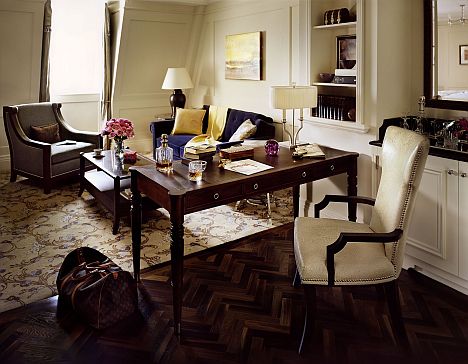
A Langham Grand Junior Suite Lounge. Photos © The Langham, London.
The façade of the Langham. Photo © The Langham, London.
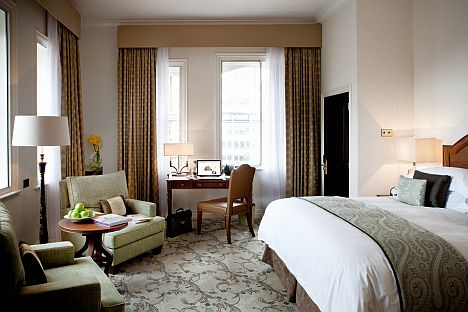
A Langham Classic Executive Room. Photo © The Langham, London.
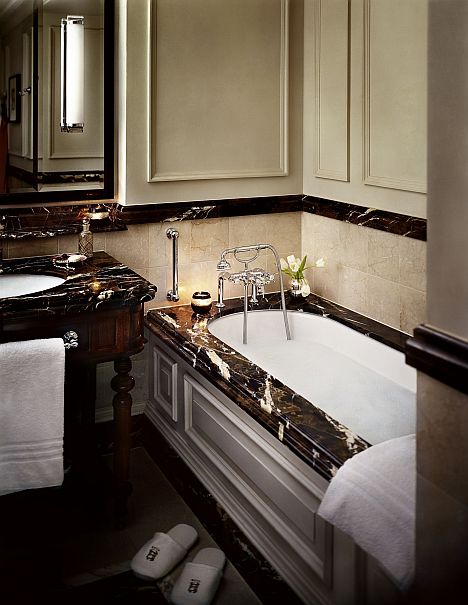
A Langham Grand Executive bathroom. Photo © The Langham, London.
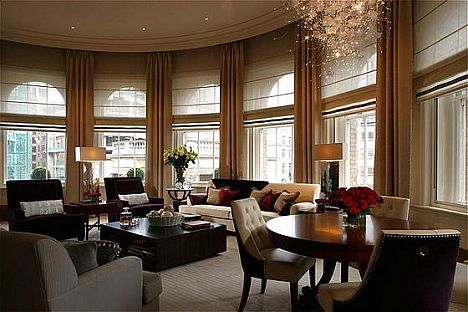
The Infinity Suite Lounge. Photo © The Langham, London.
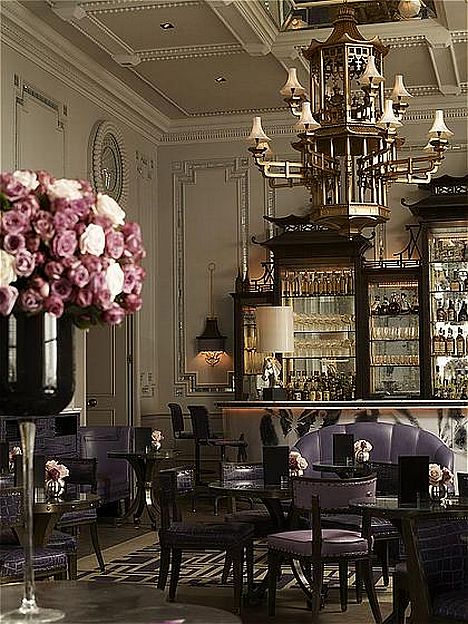
The Artesian Bar. Photo © The Langham, London.
The Langham, London history continued
Among the first American guests at The Langham was the poet Henry Wadsworth Longfellow (1807-1882). He arrived on June 28, 1868 for a two-week visit during which he received an honorary degree from Cambridge University. In his honor, a dinner with 300 guests was held at The Langham on July 9, with William Gladstone (1809-1898) as a speaker. Gladstone first hid behind the curtains, claiming that was too shy and unable to speak. He had to be persuaded to talk to the audience, which he finally did eloquently, first paying tribute to the excellence of American literature in general, then to Longfellow’s poems, before returning to the House of Commons.
The Welsh-born explorer, journalist and later Unionist MP Sir Henry Morton Stanley (1841-1904) frequently stayed at the Langham. In 1869, James Gordon Bennet of the New York Herald sent him to find the Scottish explorer and missionary David Livingstone (1813-1873) in Africa. Stanley stayed at The Langham while he was planning his journey. On November 3, 1871 he found Livingstone near Lake Tanganyika, where he pronounced his historic casual greeting: “Dr. Livingstone, I presume”. A simple “Yes” was the reply.
When the American journalist Stanley published his 730 page book How I Found Livingstone in 1872, he was already feted as a hero. After Livingstone’s death in Africa in 1873, Stanley arrived again in London, where he studied the files of stories of Livingstone’s death. The journalist stayed of course at The Langham, as he did in April 1874, when the corpse of Livingstone arrived in London to be buried in Westminster Abbey. It was the night of the burial that Stanley decided in his rooms at The Langham to make a great journey of exploration to the great lakes and the source of the Nile and then down the River Congo to the sea.
Among the other famous Americans who stayed at The Langham is Samuel Langhorne Clemens, better known as Mark Twain, the author of Huckleberry Finn and Tom Sawyer. In later life, he dissipated his fortune and energies in foreign travel.
Because of its many guests from the United States, the two libraries at The Langham and the “current literature stand” were regularly packed with American newspapers and journals. After all, US citizens were the most profitable guests, worth pampering. Charles Dickens, son of the famous novelist, rightly wrote in his Dictionary of London in 1879 that the hotel had become “a special American resort”.
The Langham Hotel Company produced a hardback, pocket-sized Guide to London, of which eighteen thousand copies were distributed in its first edition. The guide was published at regular intervals until the outbreak of the First World War in 1914.
Since Queen Victoria continued in solitude to mourn the loss of her beloved Prince Consort, Albert, who had died of typhoid in 1861, many foreign potentates visiting the capital of the British Empire were left to find their own accommodation. The Prince of Wales patronized The Langham. Visiting royalty and leaders naturally took apartments in the hotel. Former heads of state in exile were welcomed too. Emperor Louis Napoleon III spent much of his enforced exile from France at The Langham, where he occupied a suite on the first floor.
In the open courtyard of the Langham, with the help of the hotel staff of duty, Louis Napoleon III built of old carved coats of arms, unwanted sculptures and stones what he called La Fernerie, a twenty foot high Gothic folly in the form of a mock house front with an arch decorated with heraldic tiles. It stood as a monument to the exiled emperor’s final empty days for over a century.
Competition increased over the years. The Savoy Hotel in the Strand opened in 1889, with Cesar Ritz as its first manager and Auguste Escoffier, who had worked for Napaoleon III, as Head Chef. Claridges was totally rebuilt between 1898 and 1899 and the Carlton Hotel opened in 1899 and stole Escoffier from the Savoy.
Sir Arthur Conan Doyle (1859-1930), the creator of Sherlock Holmes, was a regular visitor to the hotel as his home was a short distance away. Born and educated in Edinburgh, Conan Doyle never made more than £300 a year as a doctor. In order to increase his meager income, he wrote his first story A Study in Scarlet in 1887. His Sherlock Holmes stories, first published in The Strand Magazine, brought him fame and fortune. Several of them feature The Langham.
For instance, in his first story, A Scandal in Bohemia, published in 1891, the central character was Count von Kramm, based on His Royal Highness Wilhelm Gottsreich von Ormstein, the King of Bohemia. Conan Doyle had observed him when the king stayed at the Langham. In A Scandal in Bohemia, when Sherlock Holmes asked the count where he was staying, von Kramm answered: “You will find me at the Langham under the name of the Count von Kramm.”
Among the real-life legends who stayed in The Langham were composers and musicians. Antonin Dvorak regularly visited the hotel from 1884 and wrote his Symphony No 8 in G Minor especially for English audiences. On one occasion, Dvorak tried to save money and asked whether he could share a double room with his grown-up daughter. The outraged manager of The Langham refused, whether on moral or financial grounds is unknown. (Click here for sheet music by Antonin Dvorak).
When the Prince of Wales became King Edward VII, his long association with the Langham Hotel ended. When the hotel’s board of director’s refused to employ the Swiss Cesar Ritz, whom the king claimed to have discovered, as head chef, Edward VII lent his support to Ritz starting our on hi own. The Ritz Hotel in Piccadilly, the first steel framed building in Britain, was opened in 1906.
The Langham Hotel profited from the nearby All Souls Church, built in 1824 by John Nash, one of the most fashionable places to be married in London. The hotel specialized in wedding breakfasts and receptions. Additional guests were brought in by the nearby St George’s Hall, opened in 1867, the headquarters of the London Academy of Music as well as by the Queens’ Hall, opened in 1893. The conductor Arturo Toscanini was one of the many musicians who stayed at the hotel.
In 1914 just before the outbreak of war, the hotel almost lost his reputation overnight. The Langham was managed by H. B. Robarts, who refused to serve a party of blind people. The newspapers made great play of the incident and Robarts obstinately held his ground, insisting that it was not “in the interest of the guests that blind people should be led through the hall.”
During the First World War, many hotels became government offices or hospitals for the wounded from Flanders, not so The Langham, which profited from the situation. During the war, guests made due allowances for shortcoming and shortages, which saved the hotel a lot of money in running the hotel. At the same, The Langham continued to enjoy a large turnover. Furthermore, the hotel was never a target of German bombs. The orchestra continued to play in the Palm Court.
However, during the war, the hotel grew shabby. The almost annual updating of the facilities and renovations could not be continued. At peace, the Langham Hotel Company tried to catch up under manager Stanley Parr. In 1920, the vestibule was replaced by a large neo-classical room called the Foyer. Designed by Belcher and Joass, it filled the entire original courtyard. New lifts, new wallpapers and an enlarged wedding reception room on the first floor were some of the innovations of the time. Guests could also chose between electric fire, radiator or the traditional coal fire, all separately priced as extras.
In the late 1920’s, Captain H. E. Mills took over as manager. However, he lacked the business skills to keep The Langham in the forefront of London hotels. The young went to the newer built Ritz, Savoy and Dorchester, largely because their parents preferred the old Langham. Furthmore, The Savoy and others had introduced dancing with lunch or dinner. The Langham with its history continued to attract much of the aristocracy and the English country set. In 1925, the industry magazine Caterer pointed out that the hotel was still “kept constantly full through recommendation.”
In 1919, the party for John Alcock and Arthur Brown, who celebrated the first non-stop flight across the Atlantic, taking off from St Johns in Newfoundland, was held at The Langham. Playwright and novelist Somerset Maugham (1874-1965) was a frequent hotel visitor, even after he established in the South of France in 1928.
The Langham, London history since the 1930s
Time left its toll in the hotel building and the surroundings changed. Across the street, the Broadcasting House, the headquarters of the BBC was built. In 1929-1930, Barclays built a important branch of their bank next door to the hotel. Nine years later, cracks began to appear in the walls of The Langham. The London County Council pronounced “parts of the hotel seriously defective”. The hotel builders could not foresee the vibrations and shocks the 20th century would bring. Because of the London underground railway, the hotel had to strengthen the foundations, walls and pillars of The Langham in 1931.
The 1929 crash and the following economic depression hit the hotel hard. By 1934, for the first time in its history, its shares traded below par. The nearby BBC realized it needed more space and wanted to purchase the hotel in financial difficulty. Because the price offered was too low, the hotel continued to struggle on. The guests never learnt of the difficulties and continued to book the hotel, which was particularly popular during the Chelsea Flower Show as well as the Eton and Harrow cricket match.
In the 1930’s, the hotel grew a little shabbier, the standards of cuisine however remained high thanks to Marius Dutrey once one of London’s greatest chefs. Weddings still took place, since the law demanded that bride and groom live in the vicinity of All Souls Church for three nights before the marriage could take place.
Among the famous people who visited the Langham Hotel in the 1920s and 1930s was the actor and playwright Noel Coward, a man with “A talent to amuse”, as he said about himself. He brought other British film stars to the hotel, e.g. the actresses Anna Neagle, Gracie Fields and the actor Charles Laughton (1899-1962). Today, there is still a suite named after him.
When the Australian cricket team with the most brilliant and consistent batsman ever, Captain Don Bradman (b. 1908), came to England, they chose The Langham as their base. The writer and Nobel Prize for Literature winner in 1932, John Galsworthy (1867-1933), immortalized the hotel in fiction.
During her courtship by Edward VIII, Mrs. Wallis Simpson stayed at The Langham. Her visits required discretion and the British press maintained a voluntary censorship, organized by Lord Beaverbrook, tycoon and personal friend of the uncrowned king. The public knew little about was happening until Edward’s poignant radio broadcast in which he told his subject that he could not continue as their monarch without the “help and support of the woman I love.” The coronation of the Duke of Windsor’s brother, George VI, took place on May 12, 1937 the same date as had been fixed for the abdicated king. From May 10 to 17, The Langham organized an entire week of coronation festivities, including gala dinner, dances and concerts. On coronation day alone, one thousand special trains arrived in London.
In September 1939, the British declared war on Germany. Room 24 on the Langham’s mezzanine floor was turned into a local first aid post. The hotel’s manager, Captain Hills, went off to war. Major Thomas became acting manager. During the Second World War, the hotel did reasonable business. Guests were required to dine early since the BBC building opposite the street was a prime target. During “The Phoney War” no more than a quarter of guests would bother to use the shelter in the basements if there was a night raid.
With the country at war, the hotel’s clientele changed. The traditional English guests remained in the safe countryside, the American and European tourists stayed away. They were replaced by officers on leave, the wartime staff of the BBC and those who went to the studio to broadcast.
When the French surrendered, the little known and self proclaimed “General” Charles de Gaulle arrived in London and invited French officers and soldiers on the British territory to join him. The man who later became President of France stayed briefly at The Langham.
Late in the summer of 1940, the hotel was completely evacuated twice when the level of German air raids increased. On September 16, 1940 a bomb dropped by the Luftwaffe hit one of the towers of The Langham, wrecking much of the West Wing. The novelist and playwright J. B. Priestley, the most prolific broadcaster during the war, stayed at the hotel. An urgent call from Canada House asking for a special talk to the Canadians on the Blitz saved his life since his room was destroyed by the bomb. Four days later, an incendiary bomb started a fire in the roof of the hotel. A third bomb caused additional damage on December 8, 1940.
In 1943, the BBC needed additional space and planned to buy The Langham. The hotel company wanted more money than was offered and the BBC shelved the proposed purchase. The Langham was to survive the war. John Nash’s All Souls Church, however, was badly damaged by a bomb in 1940, but completely restored in 1951.
After the Second World War, it was estimated that only eleven out of the 110 hotels listed by Baedeker in 1900 still existed. The Langham was among the ones that closed. In 1945, permission was given to the hotel to be used for offices. The BBC took over the south and west side, the ground floor and basement. Unwanted hotel furniture and effects were auctioned off. They realized that 49 of the hotels pianos had disappeared during the war. The hotel’s share capital and the stuff club funds had disappeared during the war.
In 1982, the BBC considered demolishing the old hotel. The plan was abandoned in 1985, when the company decided to build a new center at White City. The Ladbroke Group PLC purchased the building in 1986. After the group acquired Hilton International in 1987, the listed property was to be restored to its original Victorian splendor by the architects Halpern Partnership. The renovation was supervised by the building group Bovis, assisted by consultant engineers Ove Arup & Partners. 410 bedrooms and 50 suites, conference and banqueting facilities, restaurants and a business center were created. Unfortunately, the original artesian well could no longer be used for the freshwater supply, the 200-odd foot steep shaft was sealed off.
The Langham Hilton opened on March 4, 1991 with all the facilities and the comfort of a modern five star hotel. Wherever possible, the interior designers Richmond Design Group retained original features, with the assistance of English Heritage, the government agency responsible for the maintenance and restoration of historic buildings.
The style adopted by the designers for the hotel is that of the late 19th century. Among the preserved details is the stone fireplace bought in the 1920s by architect Ernest Lord from a 17th century country house to create the look of the Italian renaissance. It has been cleaned and re-set in the Chukka Bar. The ceiling in the Memories of the Empire restaurant is of a traditional Victorian design, akin to an Owen Jones concept. It was painted by hand in 1990, as it was by artists in 1865.
The official opening of the Langham Hilton was by Gloria Hunniford, a radio and television personality, whose live two-hour program on BBC’s Radio 2 that day was devoted to the hotel and its history. The first general manager was Austrian Rudi Jagersbacher, recruited from Claridges. In 1993, he was followed by Michael Shepherd.
In 1991, Diana, the Princess of Wales started becoming a regular guest – making the first official royal visit to the hotel only days after it opened. Other Royal visitors include the Duchess of Kent and Duke of Edinburgh. The then British Prime Minister John Major also attended dinners at the hotel, which hosted numerous politicians around the world. Novelist Dame Barbara Cartland, tennis star Steffi Graf, singer Rod Stewart, film director Sir Richard Attenborough and many others have been among the hotel visitors and guests since 1991.
The old Langham had a long association with London’s Jewish community. In 1905, for instance, the Jewish National Fund founded its British branch at the hotel. The Langham Hilton was keen to pursue the old Jewish connection, naming a suite after Theodor Herzl (1860-1904), who in 1897 had organized the first Zionist Congress in Basel, Switzerland and who had often stayed at the old hotel. The Langham Hilton, supervised by the Sephardi Kashrut Authority, set up a kosher kitchen with its own utensils. The hotel is a famous venue for Jewish weddings with the ceremony taking place in the Palm Court.
When I stayed at the hotel in January 2004, a Muslim conference was taking place at The Langham Hilton and the Royal Suite was occupied by a prince and his family from the Arab world.
The London Langham is located on Regent Street, in the heart of London’s West End, in walking distance from the shopping areas of Regent, Oxford and Bond Street. The Oxford Circus Underground station is some 100 meters away.
Source, literature
Tom Steel: The Langham, est. 1865: A History, 1990. The article on the left is closely based on Tom Steel’s history of The Langham. – The whereabouts of the records of the old Langham Hotel Company remains a mystery.
Added on January 17, 2011: The Langham. The Legend Lives since 1865, published in 2005 for the 140th anniversary of the hotel, 134 pages.


